


.svg)


.svg)
Why Mechanical Design Matters in a Modern Charlotte Home
You are not building a home just to admire it. You are building a place that should feel comfortable, healthy, and refined every day. That is why proper HVAC sizing, ERVs, filtration, and humidity control matter so much in a modern Charlotte home.
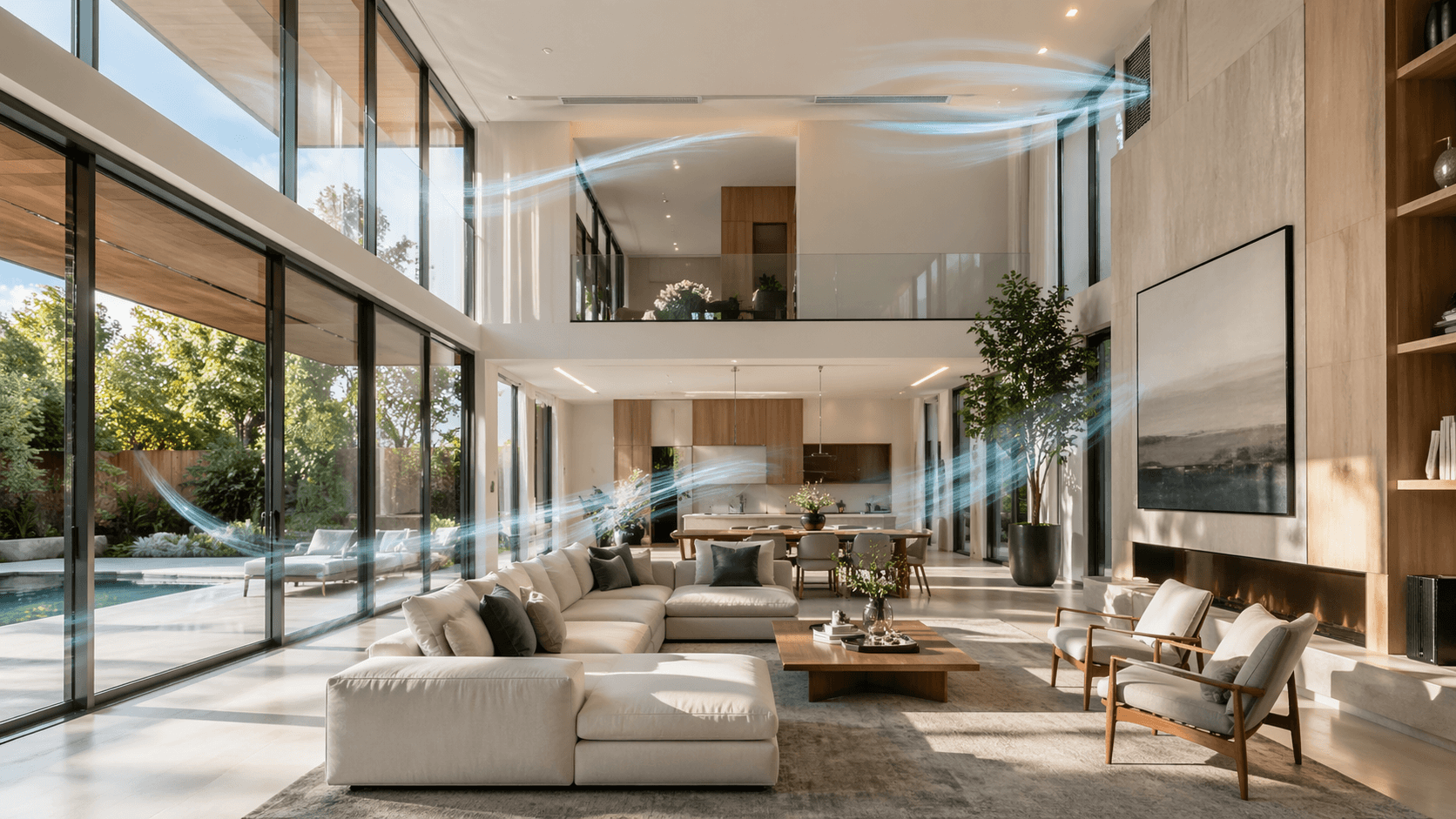
You are not building a house just to admire it.
You are building a place where your family will wake up, cook, rest, gather, breathe, and live every day. You want it to feel calm. Bright. Comfortable. Healthy. Clean. You want the architecture to feel beautiful, but you also want the home to work.
That is where mechanical design matters.
In a modern custom home, heating, cooling, ventilation, filtration, and humidity control are not background decisions. They shape how the home lives. And in Charlotte’s mixed-humid climate, they matter even more because comfort is not only about temperature. It is also about moisture, fresh air, and how the house performs as a complete system. DOE’s mixed-humid climate guidance specifically treats homes in this region as requiring climate-specific strategies for comfort, efficiency, durability, and indoor environmental quality.
At Marcello Homes, we believe a home should feel just as good to live in as it looks. That idea already sits at the center of our brand: intentional design, smart HVAC, clean and efficient layouts, and modern homes built for real life in Charlotte.
The Homeowner’s Real Goal Is Not HVAC. It Is Comfort.
Most homeowners are not asking for a complicated mechanical system.
They are asking for a home that feels right.
They want the rooms to feel balanced. They want the air to feel fresh. They want the home to stay comfortable in the summer without feeling sticky, and comfortable in the winter without feeling dry and stale. They want the beautiful design they invested in to actually support daily life.
That is the real story.
The problem is that many homes look impressive but do not live that way. A house can be visually stunning and still feel humid. It can be energy-efficient and still feel stuffy. It can have incredible natural light and still struggle with hot spots, weak airflow, or poor humidity control if the mechanical system was treated as an afterthought.
Why Modern Homes Need More Careful Mechanical Design
Modern homes are different from standard builder-grade homes.
They often have oversized windows, larger areas of glazing, open layouts, taller ceilings, and cleaner detailing. Those design choices are part of what makes modern architecture feel so compelling. Marcello Homes describes this well in its own language: spaces that are full of light, functional, grounded, fresh, and rooted in intentional design.
But those same choices also change how the home performs.
More glass can mean more solar heat gain. Orientation matters. Shading matters. Ceiling height matters. Window performance matters. That is why the load calculation has to be done properly. HVAC equipment should not be sized using rough rules of thumb or simple square-foot assumptions. DOE-backed residential guidance points to ACCA Manual J or equivalent room-by-room load calculations that account for factors like climate, orientation, and enclosure performance, including windows. Oversized systems can short-cycle and leave humidity behind, while undersized systems can struggle during peak conditions.
In other words, modern architecture changes the HVAC equation.
The Risk of Waiting Too Long to Think About HVAC
A lot of homeowners spend months refining floor plans, windows, kitchens, and finishes, then discuss HVAC too late.
By then, major decisions are already locked in. Ceiling space is tighter. Duct routes are compromised. Return placement becomes an afterthought. Ventilation gets squeezed into leftover space instead of being designed into the home from the beginning.
That usually leads to a system that fits the house, but does not truly serve it.
A better approach is to think about the mechanical system early, while the home is still being shaped. That is how you make sure the architecture and the performance support each other, instead of competing with each other.
Why This Matters So Much in Charlotte
Charlotte is not just warm. It is humid.
That distinction matters. A house can hit the thermostat setting and still feel uncomfortable if humidity is not well controlled. EPA guidance for homes consistently points to keeping indoor relative humidity in a moderate range, commonly around 30% to 50%, because higher humidity contributes to comfort issues and increases the risk of mold and other indoor air quality problems.
That is why a modern home in Charlotte needs more than basic heating and cooling. It needs a plan for:
Fresh air
How the home brings in outdoor air in a controlled way.
Filtration
How the home removes fine particles and supports cleaner indoor air.
Humidity control
How the home stays comfortable during long humid months.
Seasonal balance
How the home avoids feeling overly dry in winter or overly damp in summer.
What a Better Mechanical Strategy Looks Like
This is where Marcello Homes becomes the guide.
Our role is not to bury clients in technical jargon. Our role is to help them make smart early decisions so the home they are building will feel exceptional once they live in it.
1. Choose the heating and cooling approach based on the home
Some homes may be a strong fit for heat pumps. Others may lean toward gas heat or a dual-fuel approach. Inverter-driven systems are often attractive in design-driven homes because they can modulate output, which usually leads to steadier temperatures and quieter operation than simple on-off equipment. DOE and ENERGY STAR both frame HVAC design around proper system selection, ventilation, and commissioning rather than one-size-fits-all choices.
2. Size the equipment properly for modern architecture
This is one of the biggest issues in modern custom homes.
Oversized windows and large glazed walls are not just aesthetic choices. They directly affect heating and cooling loads. That is why proper Manual J-style load calculations matter. The system should be designed around the actual construction of the home, including glazing, orientation, insulation, air sealing, and room-by-room conditions. DOE-backed guidance specifically warns that oversized cooling equipment can satisfy temperature too quickly and fail to remove enough moisture.
3. Bring in fresh air intentionally with an ERV
In a tighter, better-built home, fresh air should not come from random leakage.
ASHRAE Standard 62.2 is the benchmark for residential ventilation, and ENERGY STAR’s National HVAC Design Supplement also requires ventilation airflow design rates that meet ASHRAE 62.2 or a later edition. In practical terms, that is why an ERV can make so much sense in a modern Charlotte home. It helps bring in fresh air and exhaust stale air in a controlled, balanced way.
4. Think seriously about filtration
If a homeowner wants cleaner indoor air, filtration has to be part of the conversation.
ASHRAE’s recent update to 62.2 raised the residential filtration requirement referenced in the standard to MERV 11, which reflects how much more attention indoor air quality is getting in homes. EPA also recommends MERV 13 or the highest level a system can handle for stronger particle removal in many situations. The key is compatibility. A stronger filter should be designed into the system, not forced into it later.
5. Control humidity, not just temperature
This is a major issue in Charlotte.
DOE’s residential dehumidification guidance notes that in humid climates, air conditioning alone may not always keep indoor relative humidity below 60%, especially at part-load conditions. Building Science guidance for mixed-humid, high-performance homes goes further and supports supplemental dehumidification to maintain comfort and control moisture.
That means a whole-house dehumidifier is often worth considering in a modern Charlotte home, especially one with a tighter envelope and better insulation.
6. Consider whether winter humidification makes sense
Not every home needs a humidifier, but some do.
If a home feels too dry in winter, especially with certain heating strategies or very tight construction, controlled humidification may improve comfort. The goal is balance, not excess. The right answer depends on the house and the family living in it.
What Success Looks Like for the Homeowner
When the mechanical system is designed well, the homeowner wins.
The home feels fresher.
The rooms feel more balanced.
Humidity is better controlled.
The air feels cleaner.
The architecture is supported instead of undermined.
The home feels refined not just visually, but physically.
That is the real outcome people are after.
They are not trying to become HVAC experts. They are trying to create a home that feels exceptional to live in.
Why Marcello Homes Talks About This Early
Marcello Homes is a custom home builder in Charlotte NC focused on modern custom homes that are both gorgeous and livable. The reason we care about mechanical design is simple: the invisible systems affect your daily experience just as much as the visible details do. That fits directly with our own message around design-driven expertise, transparent process, and homes built with smart HVAC and intentional design.
You should not have to choose between a beautiful home and a comfortable one.
A well-designed modern home should give you both.
Final Thoughts
If you are building a modern home in Charlotte, the mechanical system should never be treated like a side note.
It affects how the home breathes.
How it filters.
How it handles humidity.
How it responds to all that beautiful glass.
How it feels in July.
How it feels in January.
How it supports the life you want to live there.
A beautiful home should not only look the part.
It should live the part too.
Ready to Build a Modern Home That Feels as Good as It Looks?
If you are planning a custom home in Charlotte and want more than just a pretty set of plans, we would love to talk.
At Marcello Homes, we help clients think through the details that truly shape daily living, from architecture and layout to smart HVAC, comfort, and long-term performance. Because a modern home should be full of light, beautifully built, and deeply comfortable to live in.
Let’s talk about your home, your goals, and how you want it to feel.
FAQ
What is the best HVAC system for a modern custom home in Charlotte?
The best HVAC system depends on the design of the home, the amount of glazing, insulation levels, airtightness, humidity goals, and how you want the house to feel. In Charlotte, many homeowners compare heat pumps, gas furnaces, dual-fuel systems, and inverter-driven equipment because our climate requires both cooling performance and humidity control. Proper sizing and ventilation design matter just as much as the equipment choice itself.
Why do oversized windows affect HVAC design?
Oversized windows and large glazed walls increase the importance of proper load calculations because solar gain, orientation, shading, and glass performance all influence heating and cooling demand. In modern homes, HVAC equipment should be sized for the actual home, not by simple square-foot rules.
Do modern homes in Charlotte need an ERV?
Many do. In tighter, more energy-efficient homes, fresh air should be brought in intentionally rather than through random leaks. ASHRAE 62.2 and ENERGY STAR-aligned design guidance both support planned residential ventilation, which is why an ERV is often a smart option in a modern Charlotte home.
Is a MERV 13 filter worth it in a house?
For many homeowners, yes. EPA recommends MERV 13 or the highest filter level your system can accommodate when better particle filtration is the goal. The important part is making sure the HVAC system is designed to handle the added resistance properly.
Do I need a whole-house dehumidifier in Charlotte?
Not every home needs one, but many higher-performance homes in Charlotte benefit from supplemental dehumidification. In humid climates, cooling equipment alone may not always keep indoor humidity at a comfortable level, especially during part-load conditions.
Can a house have hospital-grade air quality?
A home is not a hospital, but it can absolutely be designed with a much more serious approach to indoor air quality than standard construction. That usually means combining better ventilation, stronger filtration, humidity control, source control, and thoughtful system design.
.png)